
Be a cat. Cause chaos. Chase clout.
Clout & Catnip is a satirical 3D comedy game where players become a mischievous house cat, turn everyday antics into viral content, and grow their social media following.
From knocking glasses off tables to unravelling toilet paper, players explore an apartment, interact with their surroundings, and capture their most entertaining moments through TikCat, the game’s fictional social media platform.
I led the project from initial concept to a playable demo, combining game design, game UX, systems design, AI-assisted development, and iterative playtesting.
MY KEY ROLE
Solo Project Lead
Game Designer
UX Designer
Game Developer
TYPE
Independent Game
Personal Project
TIMELINE
7 Sep 2026 – Present
PLATFORM
Web Browser
Desktop
TOOLS
Godot
Figma
ChatGPT
Codex
SCOPE
Concept to Playable Demo
STATUS
Ongoing Development
01: THE CHALLENGE
Turning everyday cat behaviour into meaningful play
Cats are naturally unpredictable. They knock things over, squeeze into boxes, climb furniture, and create chaos without needing a reason. But what makes these behaviours entertaining to watch doesn’t necessarily make them engaging to play.
I wanted to create a game that captured the spontaneity of being a cat while giving players a clear sense of purpose, progression, and reward. The challenge was finding the right balance between free-form exploration and structured gameplay.

Cause Mischief

Strike a Pose

Chase Clout
02: EXPERIENCE DESIGN
From Cat Antics to Internet Fame
I wanted players to feel free to act like a cat, but without losing sight of their purpose. The challenge was connecting spontaneous exploration with a structured gameplay loop that made each discovery feel rewarding.
Rather than assigning traditional missions, I designed the experience around a simple idea: everyday mischief could become social media content.
Designing for Different Types of Mischief
Not every cat behaviour feels the same. Some moments are adorable, others are playful, and some are outright destructive.
I organised content opportunities into three categories to give players a variety of experiences while establishing a foundation for the game’s content discovery system.


Balancing Freedom with Direction
One key design decision was letting players explore the apartment freely rather than complete interactions in a fixed order. To provide structure without restricting exploration, I introduced a system that highlights a content category and tracks discovered opportunities. Players can pursue the featured category or continue experimenting with other interactions.
HUD STATES


03: PROTOTYPING & PRODUCTION
From Concept to Playable
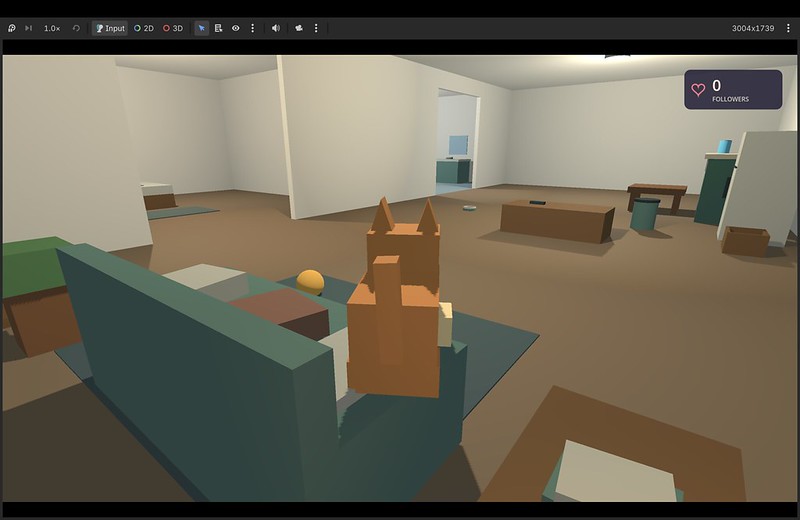
I explored different visual styles, spatial layouts, and technical approaches to find the right balance between a playful exploration and an intuitive player experience.
Through rapid prototyping and AI-assisted development, I translated early concepts into a playable 3D vertical slice, continuously refining the game based on hands-on evaluation and player feedback.
EARLY EXPLORATION
An early 2D top-down prototype helped me explore the core concept and interaction opportunities. As the project evolved, I moved towards a 3D environment to better support the fantasy of experiencing the world from a cat’s perspective. I also experimented with various apartment layouts to improve flow, exploration and content discovery.



MY DEVELOPMENT WORKFLOW
1. Define
Specify the player behaviour, interaction rules and expected feedback.
2. Implement
Use Codex to generate or refine scripts and scenes in Godot.
3. Test
Play in the engine to evaluate how the mechanic feels in real time.
4. Refine
Adjust the design, update the prompt and repeat.
4. PLAYTESTING & ITERATION
Building a playable game was only the beginning. I needed to understand whether players could navigate the apartment, discover interactions and make sense of the game’s social media mechanics without guidance.
Playtesting Approach
I conducted moderated and unmoderated playtests across multiple builds, observing player behaviour, gathering feedback and refining the experience through iterative design. I grouped the observations into recurring usability challenges and prioritised changes affecting the core gameplay experience.
Moderated
Observed live gameplay, asked follow-up questions and recorded moments of confusion.
Unmoderated
Reviewed gameplay recordings and feedback to identify issues without live assistance.
FINDING 1
Players Didn’t Immediately Understand the Goal
Players initially struggled to understand the terminology used & connect the game’s objectives with the social media premise, but understood the concept better after experiencing several captures.

Before: Unclear Direction
After: Clearer Feedback
FINDING 2
Players Struggled to Recognise Interactive Objects
Players could see objects in the apartment, but couldn’t always tell what they were or whether they could interact with them.

Before: Ambiguous Interaction Cues

After: Refined Interaction Cues
WHAT I LEARNED
Design for actual player behaviour
Playtesting revealed gaps between my intentions and what players understood, reinforcing the importance of testing assumptions early.
Freedom needs guidance
Open-ended exploration was more effective when paired with clear interaction cues, feedback and a sense of progression.
AI accelerates building, not judgement
AI-assisted development helped me prototype faster, but evaluating usability, game feel and design quality remained my responsibility.
Iteration is part of the experience
A technically functional mechanic isn’t necessarily enjoyable or intuitive. Repeated evaluation helped identify where the experience needed refinement.
WHAT'S NEXT
I’m continuing to develop Clout & Catnip, with a focus on improving onboarding, interaction discoverability and replayability through randomised trends, optional challenges and unlockable locations.